
Some projects refuse to die.
TKI, apparently, is one of them (but it’s very touch and go at time of writing).
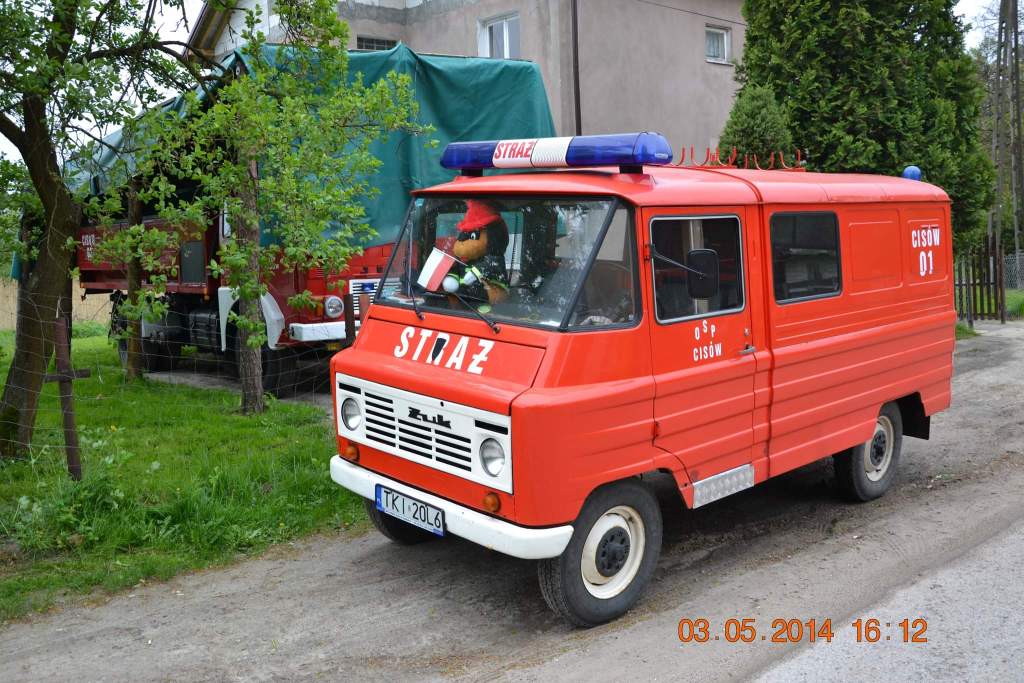
TKI 20L6 in service with OSP Cisów, 3 May 2014. Photograph supplied by OSP Cisów.
In the time since my last post, I’ve earned my doctorate, become a dad for the first time and for much of the past 3.5 years I’ve been working in China, where much of the Western internet is inaccessible and where, for a variety of equally inconvenient reasons, rebuilding a 1985 vintage Żuk in back in Britain wasn’t particularly practical.
Because the Żuk’s new roof had not been welded on, it’s been sat waiting all damp outside. Several years later however, and against all the odds, I have found my way back to the the UK and work on TKI 20L6 will begin again.
While I will save its current condition for a future update, it’s 100% true that it’s current condition wasn’t what has has brought me back to the project. It has been discovering more about where my Żuk came from.
Because long before I started cutting rusty metal out of it, changing engines and dreaming about driving a ludicrous red fire-engine camper around Europe, TKI 20L6 indeed belonged to volunteer fire brigade in Poland. Its name still visible on the side.
OSP CISÓW
Cisów is a village in the municipality of Daleszyce, in Poland’s Świętokrzyskie region. And its firefighting history turns out to be considerably older than the organisation which exists there today. OSP Cisów traces its tradition back to a local firefighting group formed during the Second World War, principally to protect the village from fires associated with military activity. The group continued after the war until the end of the 1950s, but was never formally constituted and did not have its own fire station.
Then there was a gap of more than forty year, until in 2003, local residents brought the fire brigade back. Municipal history records that the initiative came from the then village leader Tadeusz Bęben, Andrzej Lewański and Edward Zemsta. The modern Ochotnicza Straż Pożarna w Cisowie, OSP Cisów, had begun.
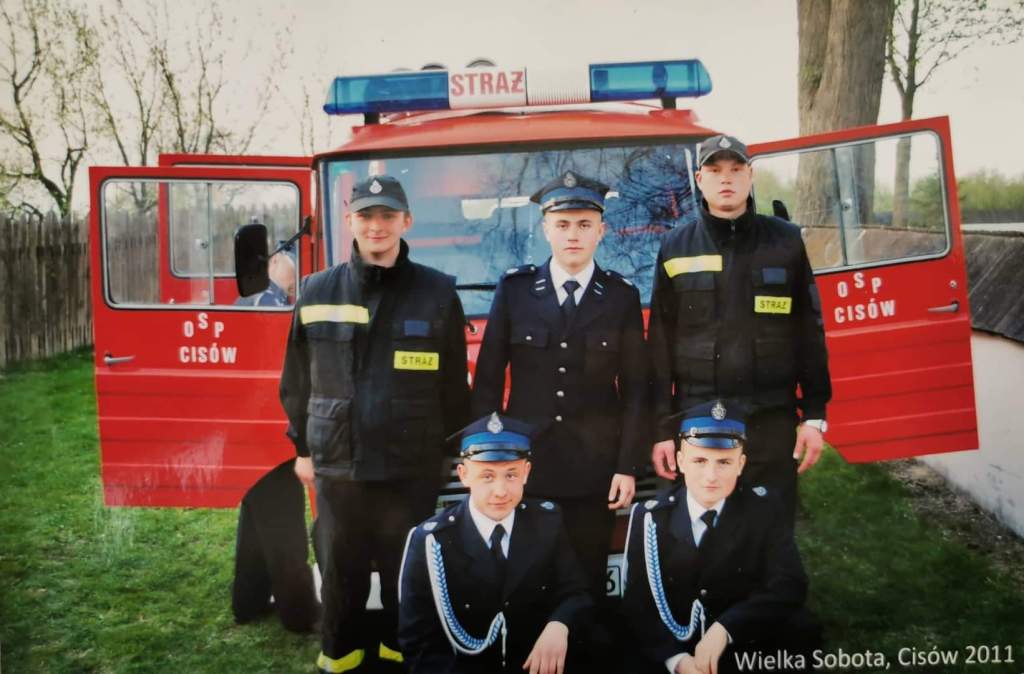
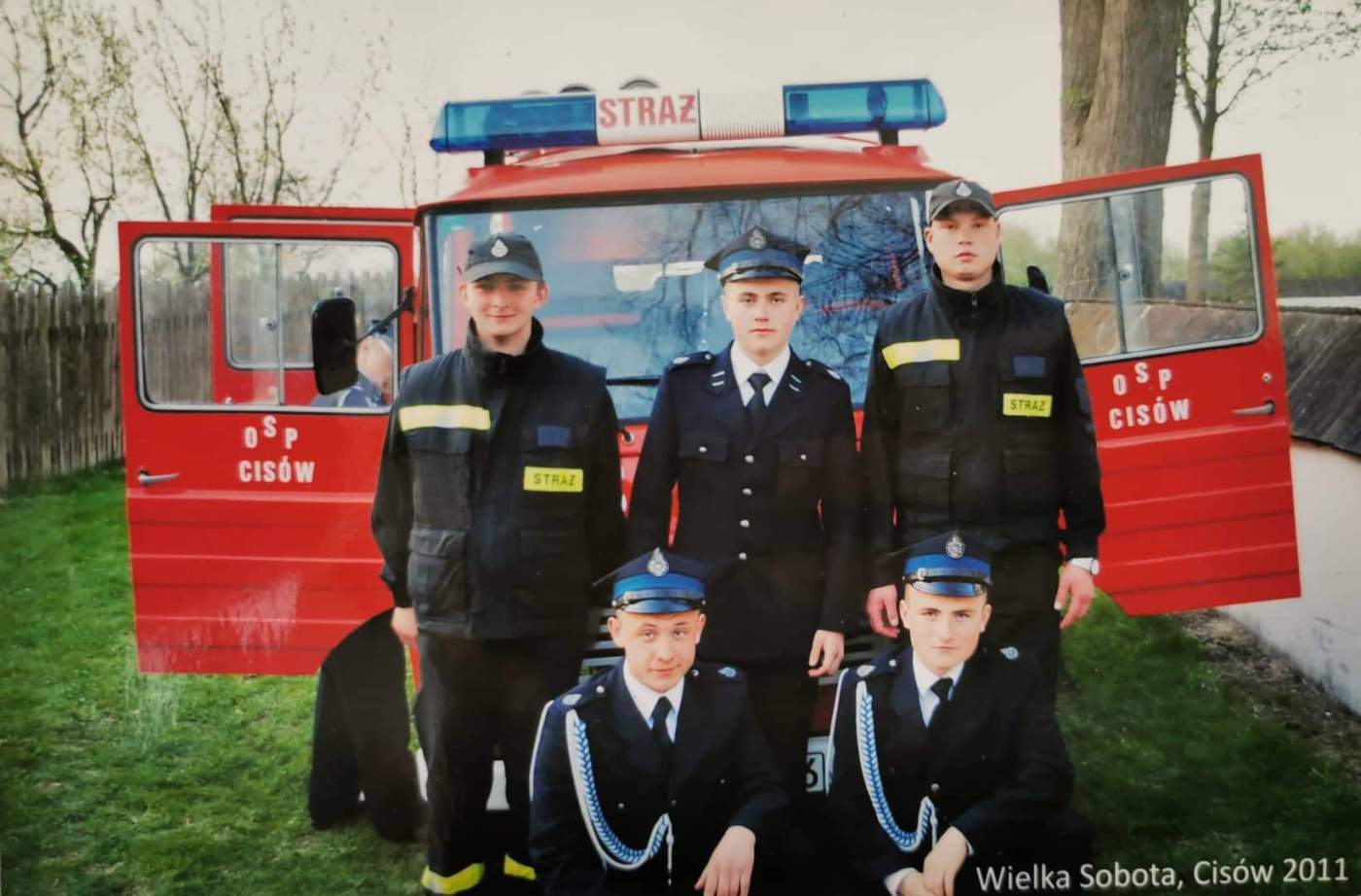
Members of OSP Cisów with TKI, Easter Saturday 2011. Photograph supplied by OSP Cisów.
And their first fire engine was a Żuk
This is the bit that has made me look at my disastrous old van rather differently. The published history of OSP Cisów records that: The first vehicle placed at the disposal of the newly formed brigade was a firefighting Żuk.
Because sitting at the other end of the country to me now I’m back in Britain is a firefighting Żuk which served with OSP Cisów. I have now gone back to my friends at the fire station to ask the obvious question:
Was TKI 20L6 actually their first vehicle? And at the time of writing, I’m waiting for confirmation, so I don’t want to turn a very plausible piece of history into a fact before the people in Cisów tell me that it is one.
But if the answer is yes, then this wasn’t merely a fire engine that happened to serve at Cisów. My Żuk may have been the first fire appliance of the modern OSP Cisów when the brigade was re-established in 2003.
To me, at very least a +1 to the importance of preserving the history of this little truck.
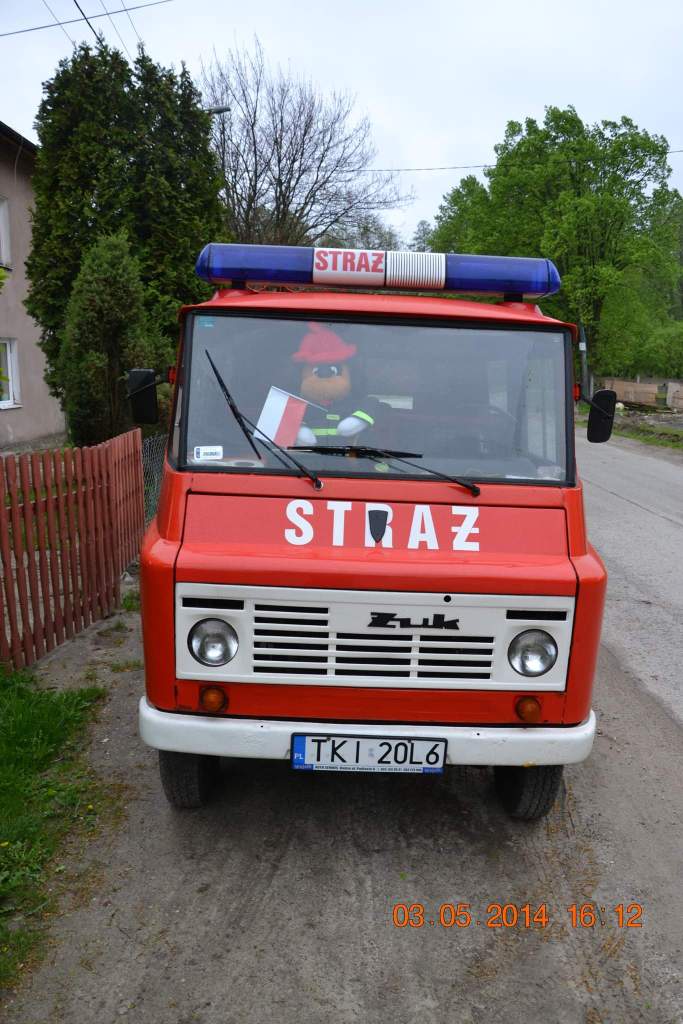
No ambiguity about the vehicle in the archive photographs: TKI 20L6, at Cisów on 3 May 2014.
TKI 20L6
The photographs OSP Cisów sent me in 2022 are wonderful because they turn the Żuk from an old vehicle into something with a life that I’d been trying to save for nearly a decade. It played a role with the people who served in the brigade and still out on the roads at the very end of its first life, complete with it’s blue lights, hoses and STRAŻ markings which were still largely present when I eventually found it.
It was a working vehicle, and it’d be interesting to know how many lives it saved too.
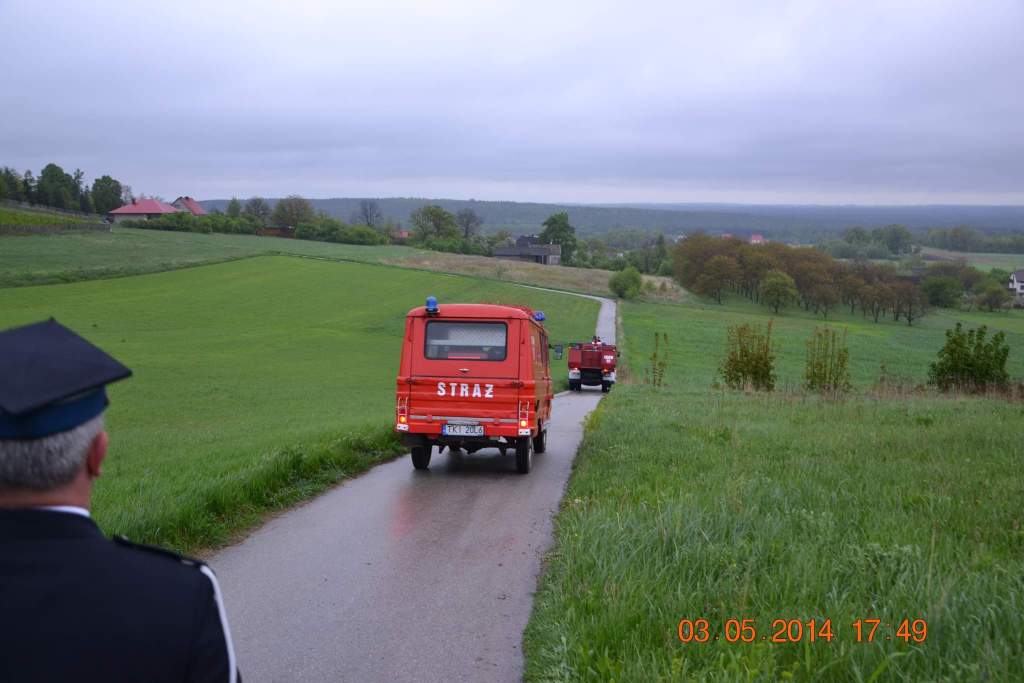
TKI 20L6 on the road from Cisów, 3 May 2014. This might be my favourite photograph of the Żuk’s first life.
There is something slightly strange about seeing it like this. I’ve spent years looking at this vehicle as a collection of never-ending jobs that are beyond my capability.
Rust. Brakes. Rust. Wiring. Rust. Engine. Rust. Roof. Rust. Interior. Rust. Camper. Money. More rust.
But the van in these photographs was just their fire engine.
OSP units are deeply rooted in Polish village life. They are volunteer organisations, but their role extends beyond simply owning a red vehicle and waiting for something to catch fire. The 2023 twentieth-anniversary celebrations at Cisów brought together the brigade, villagers, neighbouring OSP units and local government, and also saw the blessing of the unit’s first ceremonial standard. The anniversary formally marked twenty years since the current OSP was established in 2003.
The same event deliberately links today’s organisation back to Cisów’s wartime firefighting tradition. So this little Żuk belongs somewhere inside a much longer local story than a footnote about how it drove a Brit completely insane in his attempts to put it back on the road.
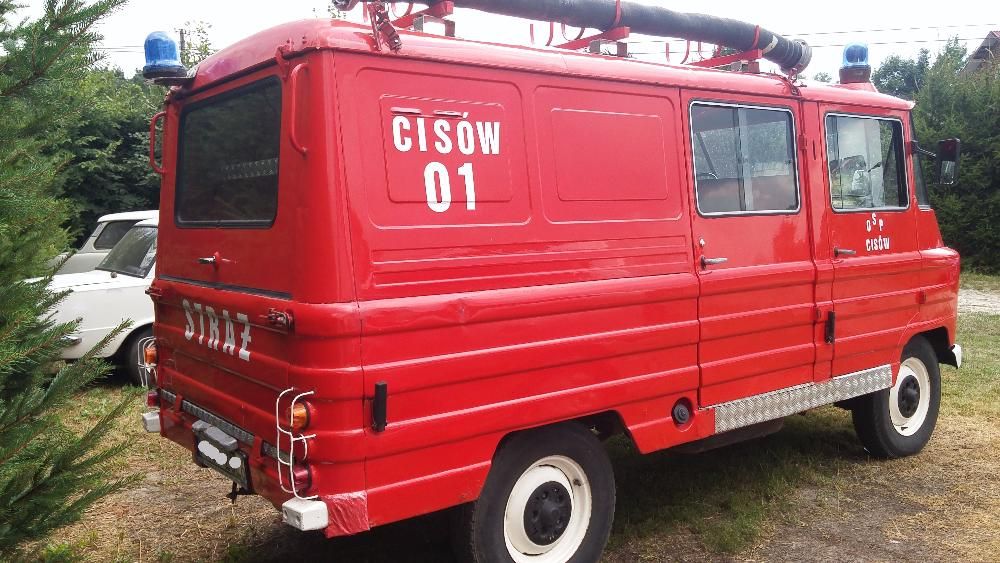
The identity it carried in service: CISÓW 01.
Finding the people who remembered it
In February 2022, I decided to see whether I could find out more. I contacted OSP Cisów through Facebook. My opening message was fairly straightforward: I explained that I was the British chap behind “Anglik robi Żuka”, that I had their old fire engine in the UK, and that I wanted to know its history.
I also told them that I was converting it into a vehicle capable of overlanding, or at least camping. Which, on reflection, was probably quite a strange message to receive from another country.
I asked whether there were any old photographs, films, documents or stories about the vehicle and said that, one day, I would love to bring it back to Cisów to visit.
The reply came from Agata. And it was lovely.
They were pleased that their Żuk had survived and that it was getting what she described as a “second life.”
Even better, they started looking through their material for me.A few months later these photographs you see in this article arrived. I remember replying that they would motivate me to finish the Żuk. That was in 2022, before I’d even left for China and life intervened rather spectacularly.
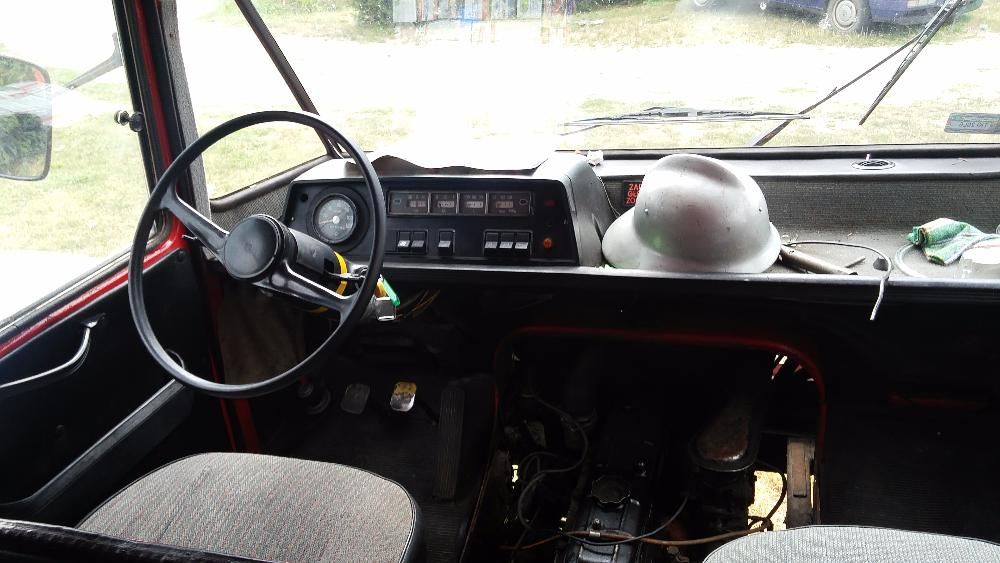
The Żuk’s wonderfully uncomplicated working environment during its Polish fire-service life.
Then Cisów contacted me
Fast-forward to October 2025. I had been away from the project for years.It’s physical condition having deteriorated far beyond “sunken-cash fallacy mode”. With me now looking for a way back to the UK. And a message appeared from OSP Cisów.
“Cześć, jak wyglądają prace nad Żukiem? Masz jakieś zdjęcia?”
Hello, how is the work on the Żuk going? Do you have any pictures?
I loved this.
Because years after the vehicle had left their village, crossed Europe and disappeared into one Brit’s collection of unfinished ideas, they were wondering how their old Żuk was getting on. I explained that I’d spent the previous few years working abroad, but that I expected to return in 2026 and restart the project.
And I repeated something that I’ve wanted to do for years:
I want to record the history of this particular vehicle, not simply the history of Żuks in general. When did Cisów acquire it? Where did it come from? Was it indeed the first appliance of the newly established OSP in 2003? What incidents did it attend? Who drove it? What equipment did it carry? When was it finally retired?
Some of those answers may still be sitting in old documents, photographs and people’s memories in Cisów and I’d like to preserve them before they disappear.
From Cisów to UKZUK
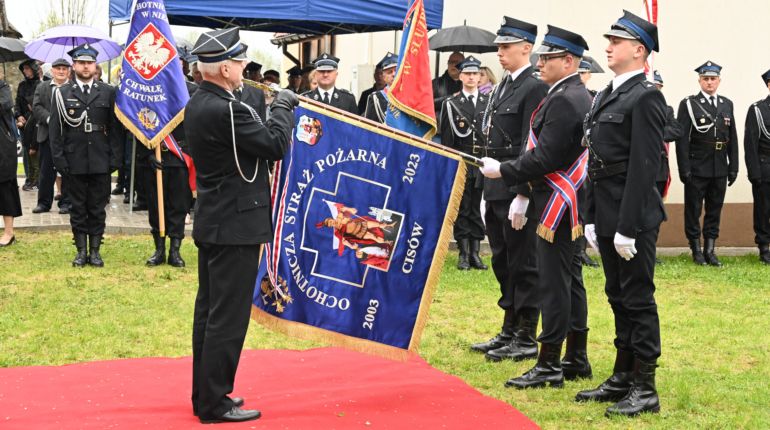
OSP Cisów’s new ceremonial standard, presented during the brigade’s 20th anniversary celebrations in May 2023. Image: Miasto i Gmina Daleszyce / CKinfo.pl. Read the original report and see the full ceremony gallery.
Eventually, of course (circa 2014/15), its Polish firefighting life ended. And somehow TKI 20L6 entered the next, rather less dignified chapter of its existence, with me.
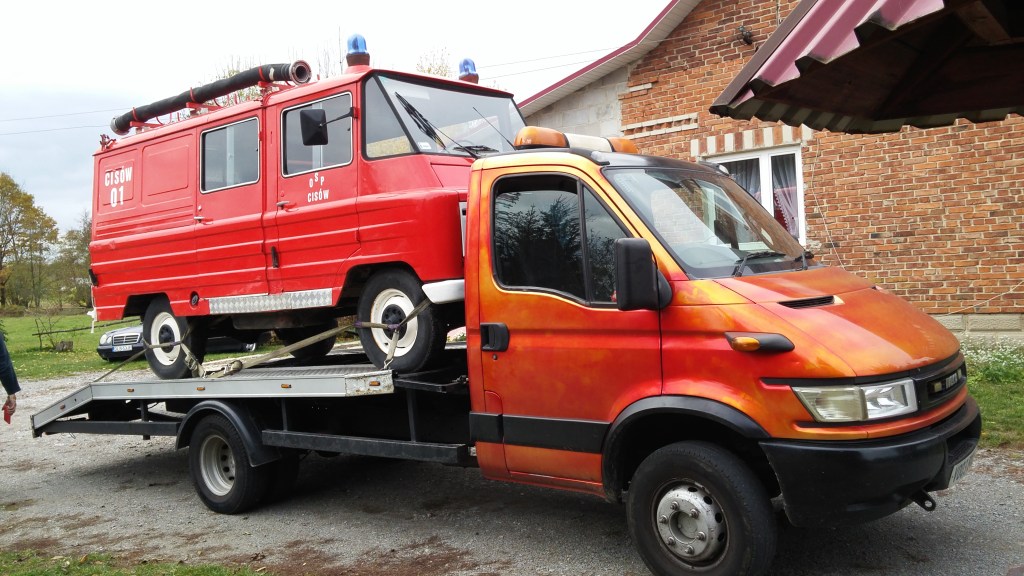
October 2016. The old Cisów fire engine begins the journey into its next life.
When I bought the Żuk, I knew almost none of this. I also thought it hardly needed any work, looked quite tidy for 500 quid too!
I could have waited and “bought a mint one”, but this one spoke to me and was rough enough around the edges I wouldn’t feel too bad about modifying here and there, as I liked Żuks, but wanted something completely different and had the increasingly questionable idea of turning one into a camper.
It was red. It was boxy. It was obscure and a total underdog that appeared to have been designed largely with a ruler.
Obviously I wanted it. What followed became this UKZUK blog and the Youtube channel.
But there was much more rust.
There was some very bad wiring.
There were strange Polish parts that didn’t belong
There was an S21 that was very unhappy.
There were wheels, lights and camper layouts.
There were even occasional moments when it even looked as though I knew what I was doing.
And then the project stopped. All my projects stopped.
My 6 month old boy came with me, but everything on the house and Żuk stopped dead for four years. The Żuk remained in Britain and UKZUK effectively went into suspended animation.
But it never went away. And four years was a lot of reflection time.
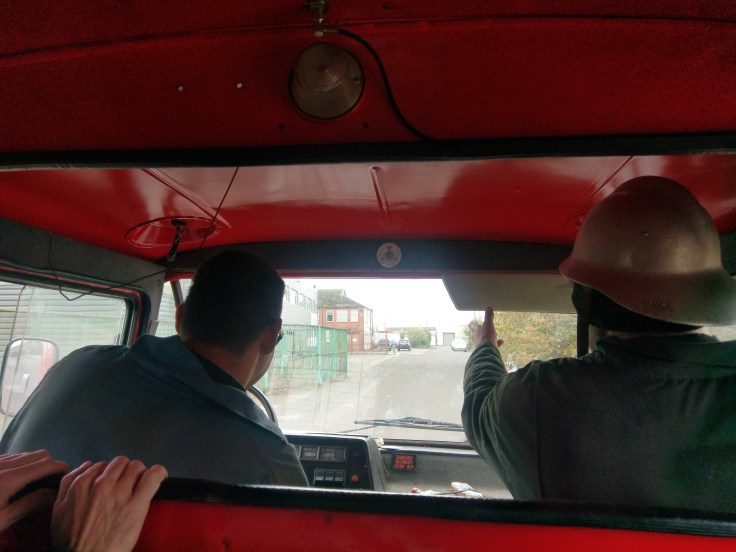
Back in 2016 there was some short-lived aspiration TKI would be a quick “get on the road” job.
Against all the odds, I’m doing this again
So here we are. 2026. I’m back in Britain. I’m making preparations to get back to the Żuk (which is some 350+ miles away). And TKI 20L6 is, against all reasonable expectations, may have some small chance of heading towards becoming the camper I promised myself it would become about a decade ago.
But there is one thing I understand now that I didn’t properly appreciate when I bought it. Its new life shouldn’t erase its old one. I don’t want to restore it into a fake fire engine, and I don’t want the camper conversion to make it invisible, or generic either.
It will have another job now, and have other humans depending(ish) on it. But wherever possible, I want to retain the things which make it recognisably the Cisów Żuk. The red (rusty) body. The character. Traces of its fire-service. But most importantly, its story.
Because before UKZUK, this vehicle belonged to a community, carried firefighters, travelling a communitie’s roads wearing CISÓW 01 on its side. And there are still people in Poland who remember it and ask after it.
So one day…
I will act on the promise buried in my original conversation with OSP Cisów. That when the Żuk was finished, I would visit them in it. I still mean it. The ultimate UKZUK road trip therefore seems rather obvious.
Scotland to Cisów. TKI 20L6, finally converted into some form of the semi-habitable camper it has been threatening to become for a decade, driving back into the village where its previous life was served – and who knows where it was stationed before 2003!?
I’ll park it outside the remiza. Meet the people who remember it. Put it beside whatever enormously more competent modern fire appliance replaced it. And perhaps recreate a few of these photographs.
I can’t think of a better ending to the build – or, perhaps more accurately, a better beginning to it’s new life.
I’d be very interested to hear your thoughts on my journey (or key moments of your own projects) below.
 UKZUK, Nysa & Tarpan
August 13, 2026 at 2:22 pm
Andy, trzymam kciuki za twój projekt reanimacji tego wozu. Realizacji tego pomysłu z całego serca Ci życzę.
Wspaniały projekt! tylko czy ten złomek zachował na sobie jeszcze dość stali?
Znając twoje “królewskie geny” na pewno się uda. Brawo, brawo i jeszcze raz brawo, oby tylko wena ciebie nie opuściła i czas pozwolił na dostarczenie go do Cisowa !
Powodzenia
Zibi z T.G.
LikeLike